
Peter Feuerherd
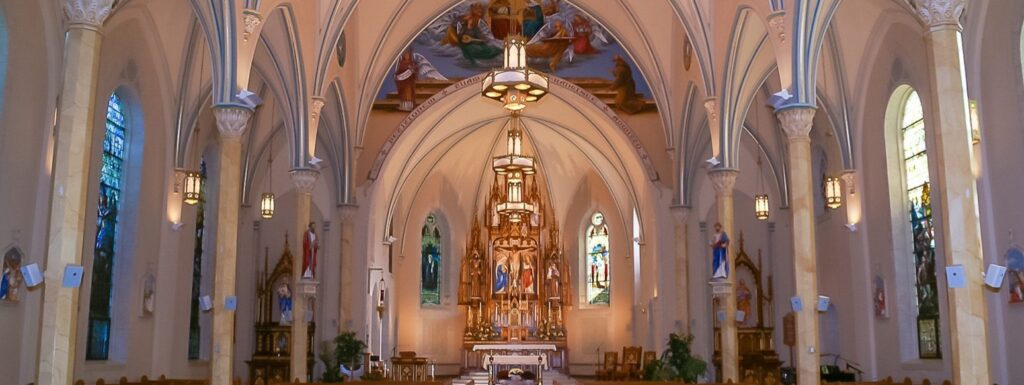
There’s a quiet for four Franciscans who live at the St. Francis Friary in Teutopolis in central Illinois. People in the Diocese of Springfield sometimes refer to it as “God’s Country,” a place where the fields stretch toward a distant horizon. It’s a flat landscape fit for amber waves of grain. Yet beneath the solitude is a quiet bustle.
“It’s been the hardest work of my entire life,” says Father Dennis Koopman, OFM, 85, who has ministered as an associate at St. Francis of Assisi Church for the past four years.
He formerly taught organic chemistry at Quincy University, a Franciscan school, was part of a preaching mission team in the Midwest, and served as a chaplain for a Franciscan Sisters’ motherhouse. Rural parish ministry has a different kind of intensity.
In his previous ministries, says Father Dennis, he could count on a set pattern. Preparation was relatively easy, whether that meant teaching or preaching around the Chicago area as well as Iowa and Wisconsin. Parish life, by contrast, is a more evolving dynamic.
While the ministry is shared with three of his fellow friars, parish life is a series of Masses, baptisms, marriage preparations, visits to nursing homes, chaplaincy for the local Knights of Columbus chapter and a Secular Franciscan fraternity, and participation in socials and other occasions integral to a tight-knit parish community which has been served by friars ever since 1858.
COMPLEX LIVES
Teutopolis is a prosperous town of 1,700 with some 1,200 parishioner families. Catholic roots run deep. The local public elementary school is on church grounds, and the early morning hours before classes are spent on religious education and Mass for the Catholic community.
The Franciscans are a large part of those roots. As their numbers increased, they expanded the friary and later opened a seminary and a novitiate nearby, facilities which closed when the friars opted for a move to Chicago to train new members in the 1960s.
While their numbers have declined, the legacy of the Franciscans remains. The friars formerly ministered in more than half a dozen churches in the area. Now they lead three parishes scattered over four churches. Three of the four friars residing at the St. Francis Friary are well past retirement age in the secular world. But, as friars, they remain involved in the lives of their parishioners.
“People’s lives are so complex,” says Father Dennis. “All have problems. They bring them to the priests.”
The friars’ ministry extends beyond Teutopolis. Father Juan Carlos Ruiz is pastor for St. Isidore the Farmer Parish, which consists of two churches and is based in Dieterich, eight miles away. Father Ruiz, at 56, is the youngest in the community, and also serves as guardian for the friary.
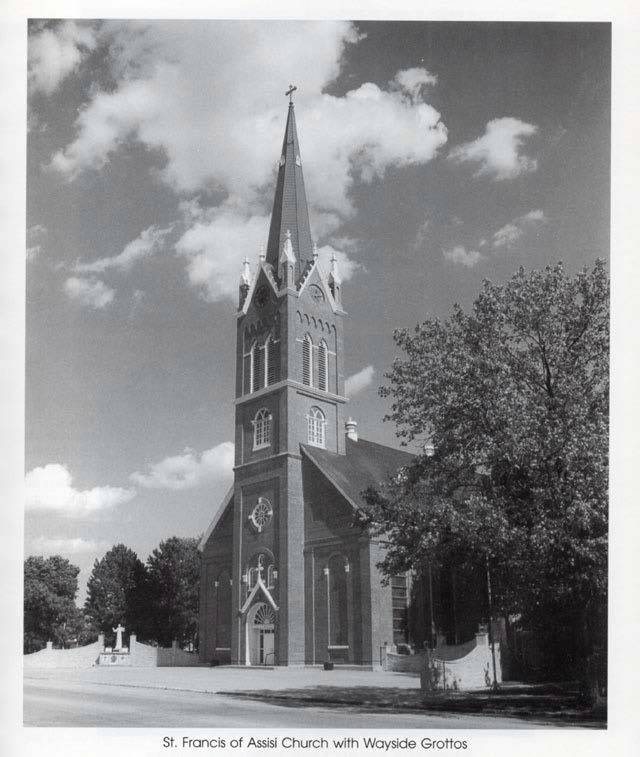
St. Francis Church is served by Father Joseph Carlos, pastor, 78. Father Carmen Scuderi, OFM, 73, arrived at the friary this year and is pastor of St. Rose of Lima Church in Montrose.
Father Joseph is a former US Naval chaplain where he served in ministry to Marines and sailors. In California, he counseled veterans from Afghanistan and Iraq. He also served in Somalia and in Guantanamo, Cuba, where he was part of an outreach to Haitian and Cuban refugees. Father Carmen formerly served as a hospital chaplain and pastor. Together the friars bring decades of ministry experience in a Franciscan style.
One goal in the bustle of parish life is to maintain Franciscan community. Amid their parish duties, the friars come together each day for morning prayer, the reciting of the Divine Office, and meals. Father Juan Carlos splits his time between his parish and the friary. He also serves as director of Hispanic ministry at Sacred Heart Church in Effingham.
Father Juan Carlos is particularly well-equipped for ministering to the growing Latino community in the area, many of whom came to work on farms. He is a native of Guadalajara, and previously served as a friar in parishes in Chicago and Indianapolis, as well as a chaplain at Quincy College. Rural parish ministry is new to him, having been appointed for St. Isidore a little over a year.
IN GOD’S TIME AND PLACE
All is not calm. World events have made an impact on the region. The ups and downs of tariffs and international markets have an impact on the livelihood of farmers. For the region’s Latinos, recent events of mass deportations in Chicago send a fearful message for those from Mexico, Guatemala, and Venezuela.
Father Juan Carlos notes that a Latino parishioner was detained recently after filling up at a local gas station with a friend who was an immigration target. Fear is pervasive.
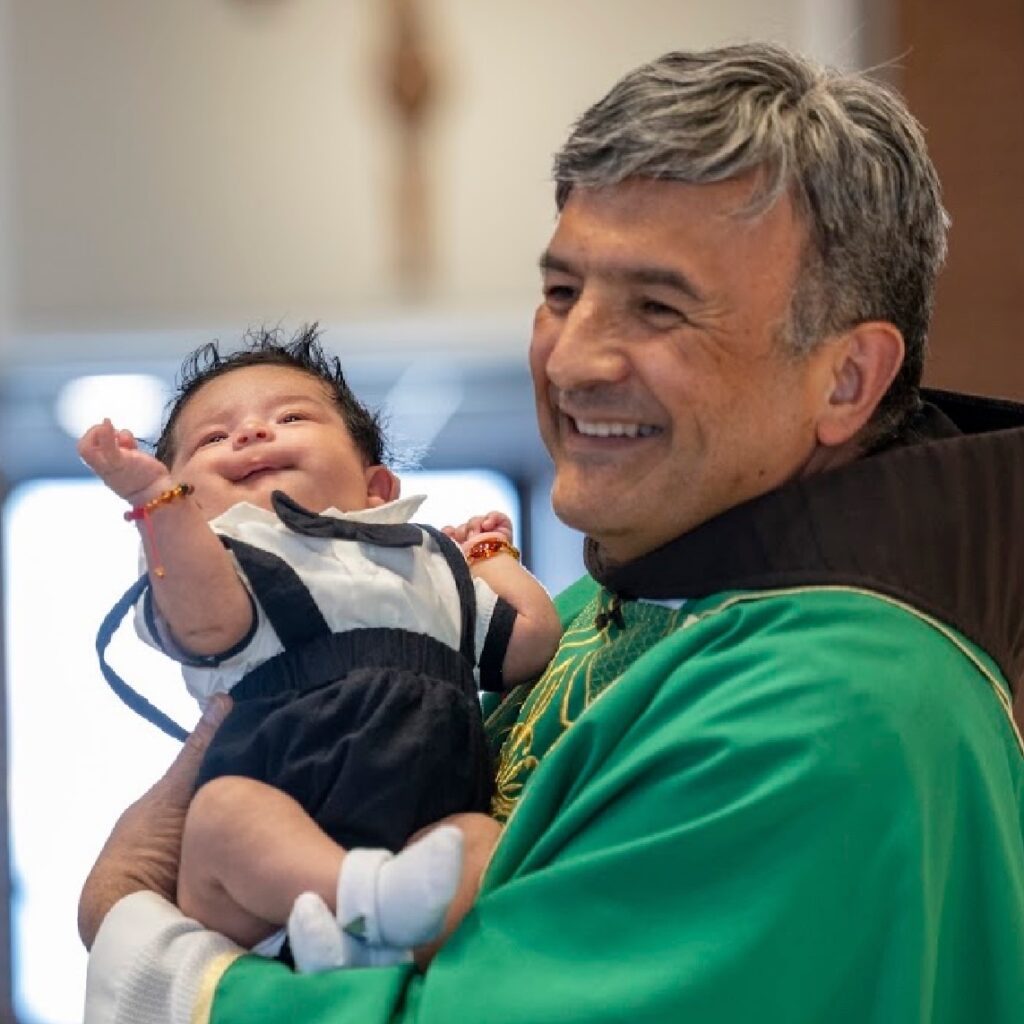
The pastor tries to offer leadership, inviting the local sheriff to talk to parishioners after Mass to assure them that the local law enforcement officials are not targeting them for immigration enforcement.
Father Juan Carlos knows what his immigrant parishioners face. He came to this country at 19, and worked in retail stores and construction in Oregon, Utah, and New Jersey, all while communicating with his nine siblings in Mexico and the United States.
Along with his desire to work, he brought with him a dream to be a priest. He had studied at a Mexican seminary and felt attracted to ministering within a community setting. The Franciscans fit that desire. His parishioners, most of whom are of German ancestry, appreciate their Mexican American pastor. He brings a presence to the community.
“People value the effort,” says Father Juan Carlos.
Parish ministry is a long Franciscan tradition. Father Dennis notes that the Franciscans bring their unique style. Focus remains on serving the poor, working in community, and recognizing God’s creation in a rural farming setting. Parishioners appreciate the Franciscan presence.
Every new day brings more ministry opportunities. While he is on the move constantly, Father Juan believes he is where God wants him to be, serving the people of central Illinois with his fellow friars in a place where the quiet fields are tended amid the complexity of modern American life.