

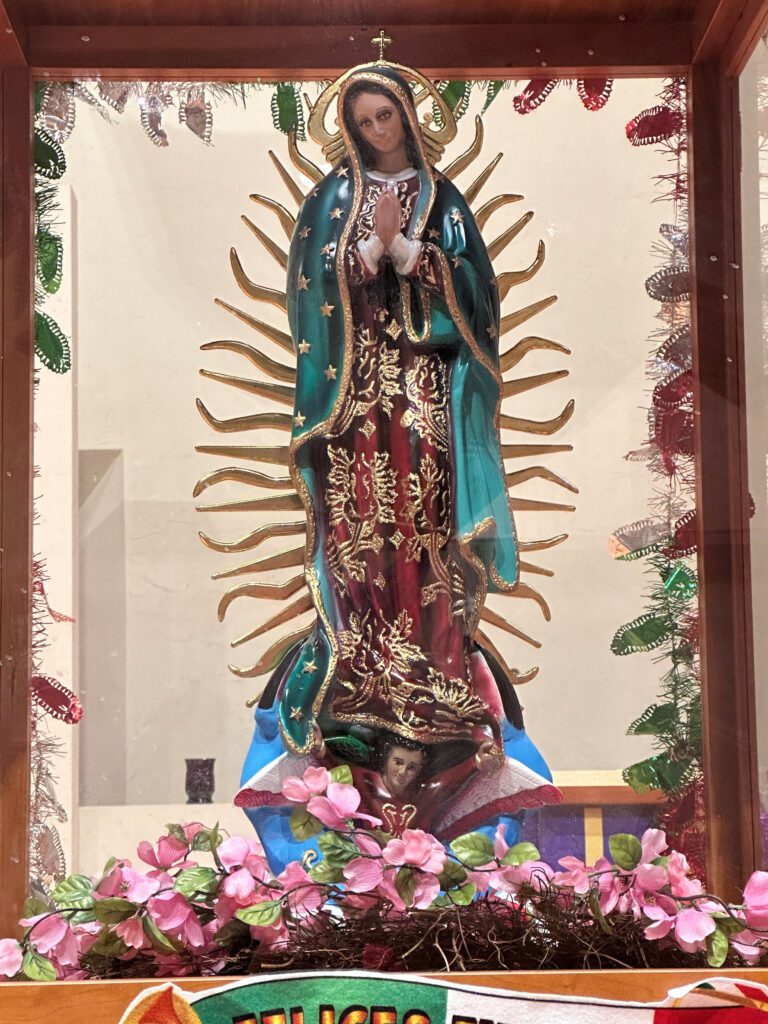
Back in October 2023, the OFM friars from across the United States joined together to forge a single new province from five legacy friar communities across the country. Bro. Lawrence Hayes, OFM, was selected as provincial for the new Province of Our Lady of Guadalupe, based in Atlanta.
In a recent interview, Bro. Lawrence noted that the new province is forging ahead. He likens it to an adolescent at this stage, coping with change, sometimes with awkward moments yet looking forward to what is to come.
“When you become a teenager things start happening to you,” he said, including bodily changes and being thrown into situations beyond the comfortable routines of home life. Questions arise, he said, including “Who am I? What am I here for?” Over the past decade, the friars have been asking the deep questions.
Similarly, the Province of Our Lady of Guadalupe is “going into a new identity,” forging something different from the five former provinces, each one with a long tradition of following unique ways of ministry and fraternity. Each group had its own prayer styles, its own experience of formation and fraternity, with many aspects in common yet with distinct styles of their own. The legacy provinces had long-established ministries and institutions of their own.
Fr. Larry noted that the new province is something like a marriage, where the partners discover the customs and culture of each other that derive from their birth families. It’s a particular challenge for friars who were formed with a strong provincial identity, particularly those who entered the community when the legacy provinces worked separately.
But years of gradually moving towards a union proved fruitful.
He noted that younger friars have been educated and formed in communities which included postulants and students from the legacy provinces, as those provinces began merging their initial formation programs long before the formal union. Thus, serving with friars from all over and working in ministries beyond old province boundaries is something many younger friars take for granted.
While there have been growing pains, strengths forged by the new province are beginning to emerge. Assignments to a diversity of ministries can now draw on a larger pool of friars. Some friars have grown to enjoy ministries in regions of the country they never experienced before. Creative approaches have emerged, including beginning a friar community devoted to evangelization in Charlotte, North Carolina. That mission is to reach out to the unchurched in taverns, town squares, social media, and spaces where formal church entities rarely go.
The friars in Charlotte are discovering new ways to reach the unchurched in what is often described as a “post-Christian culture,” said Fr. Larry, a signal that creative approaches in the new province have begun to emerge.
Franciscan universities, including Siena near Albany, New York; St. Bonaventure, Olean, New York, and Quincy in Illinois, are joining in collaborative arrangements based upon a shared Franciscan heritage.
The province’s location in Atlanta is also a positive.
The Atlanta airport – the largest in the nation – offers easy access for friars coming from across the U.S. The old line, says Fr. Larry, is “if you want to get to heaven, you will have to change in Atlanta.”
But the location provides more than convenience. It’s also a concrete reminder for friars to seek out new ministries in the South, a growing region where the presence of the friars has till now been limited. Archbishop Gregory John Hartmayer of Atlanta is most willing to explore how Franciscans of the new province can minister to the church in the archdiocese.
A year-long provincial synod process, culminating in a January 2025 conference in Kansas City, Missouri, resulted in a set of eight priorities. They include a focus on developing friar fraternities, with an emphasis on better communication within communities and promoting better care for aging friars; outreach to the poor and marginalized, as well as to young adults; promoting lifestyles consistent with Franciscan values; deepening ongoing formation on the Franciscan tradition; developing the contemplative dimension of the Franciscan charism; promoting creativity in ministries, and challenging structures which have an adverse impact on the poor.
The synod priorities emerged from extensive consultations with friars and their partners through a process intended to mirror the wider Vatican synod process undertaken by Pope Francis before his death last year and continuing with Pope Leo.
The priorities serve as guideposts for “what we want to put our emphasis on going forward,” said Bro. Lawrence, expressing confidence that the adolescent nature of the Province of Our Lady of Guadalupe will, with time, emerge into a faithful and creative adulthood.