
How did we get here? Where could this conflict lead us next?
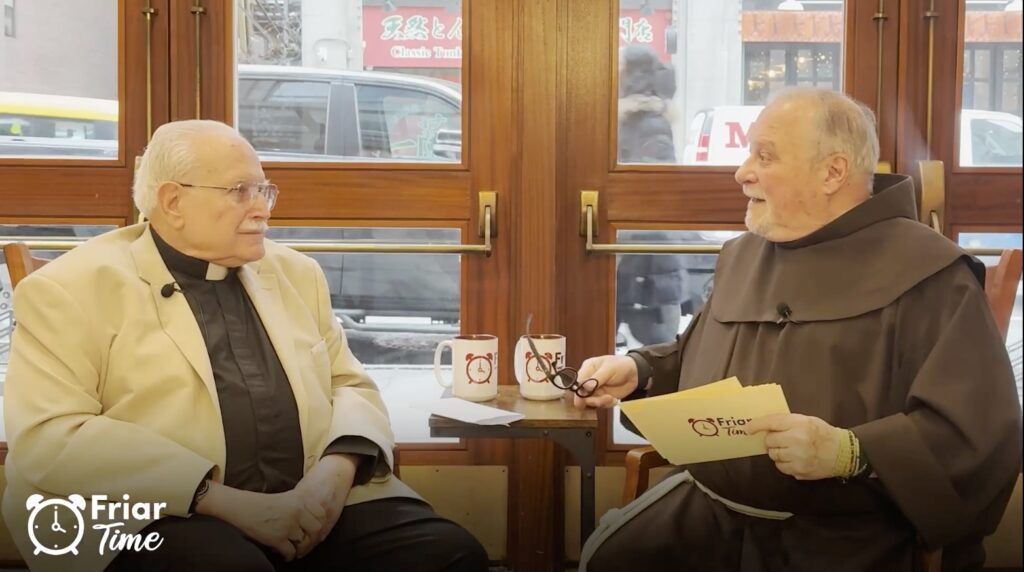
Host Fr. David Convertino, OFM, welcomes Rev. Elias D. Mallon, SA, STL, PhD to Friar Time.
On March 21, Franciscan TV’s popular discussion show, Friar Time, welcomed Rev. Elias D. Mallon, SA, STL, PhD to get his uniquely informed insights into the Middle East. Rev. Elias is a Catholic priest and member of the Franciscan Friars of the Atonement who has been engaged in the Christian-Roman Catholic-Islamic dialogue locally, nationally, and internationally for 40 years. He has published two books and numerous articles on Islam and the Christian-Muslim dialect. Rev. Elias is presently the assistant to the president of Catholic Near East Welfare Association, a faith-based humanitarian aid organization, as well as a pontifical organization.
“Elias, welcome,” began Friar Time’s host, Fr. David Convertino, OFM. “So many people think that the Middle East conflict just began recently, but historians often trace today's tension back to events like the collapse of the Ottoman Empire, and the drawing of borders after World War I. How much of today's violence do you see is rooted in those 20th century decisions?”
“Almost all of it,” answered Rev. Elias. “And it's probably deeper and more complicated and more interjoined than people realize. I remember when I was in college, sometimes we would get called to help with firefighting and with forest fires. One of the things I learned about that I didn't know is called a root fire. And that's where the roots are burning and not the tops of the trees. And the flames can pop up anywhere. You think it's out, but it's not. The Middle East is like a root fire. That you see something, violence in northwestern or northeastern Iraq, and you see violence in Gaza. And you don't think they're connected. They ultimately are.”

“What's this underlying conflict that is causing all this?” asked Fr. David.
“It's non-responsive governments all around,” replied Rev. Elias. “It's repressive governments all around. There is no sense of cohesion, social cohesion, or political cohesion in the countries of the Middle East. They're all artificial constructs. None of those countries existed before World War I. They don't have a sense of cohesion. You're a Sunni, you're a Shia, you're a Maronite, you're a Druze, you're Syrian or Lebanese—the identities are more parochial. There's no sense of a national identity except in Iran. In Iran, there is a clear sense of a national identity.”
So, in a lot of these countries, and I use this phrase advisedly, it's ‘every man for himself.’ It's not the common good, which is hard enough to maintain in normal times. In lawless times, it's impossible to maintain. ‘I'm out for it for what's in it for me, and I don't care what happens to you.’ And that's endemic in the Middle East. That's endemic, whether it be the Sunni, the Shia, and the Maronites in Lebanon, whether it's the people in Mosul in northern Iraq, in Baghdad in central Iraq, or in Basra in southern Iraq. There's no sense of a common cohesive culture or nation there. And, so, there's a lot of internal competition, which you do not get in Iran, not at all, because they are a country that has existed for 5,000 years, as Persia and Iran. There's a sense of identity in Iran that you don't find in many other places in that particular part of the Middle East.”
“If the war continues, what are the three most likely outcomes?” asked Fr. David. “Collapse of the Iranian regime, prolonged regional wars, or an uneasy ceasefire?”

Is there hope for peace in the Middle East? Rev. Elias D. Mallon, SA, STL, PhD answers this pertinent question and more on Friar Time.
“What about all of the above?” counters Rev. Elias. “Maybe it'll stamp the fire out for a while, but it's going to come up again. It'll come up somewhere else in the region, because the underlying problems of people having a safe life with the possibility of having a better life and raising their children, educating their children, and dying at a rank old age is not attainable. And that's ultimately what people want. And as soon as people have no hope, they'll grab at anything they can get. And if somebody comes and promises them, ‘let's go in and kill our enemies’, well, it's better than letting them die.”
“So, is there no hope of lasting peace in the region?” asked Fr. David.
“Not until there is a representative justice,” replied Rev. Elias. “And (I mean) more than forensic justice. (Not until) people's rights and their aspirations are respected, and that governments exist to help people, not to have wars. In many Western European countries, socialist countries, the purpose of the government is to protect and develop the welfare of the population. That's a very different way of looking at things. Is a government there for war or is a government there to make people's lives better?
Ultimately, it's when governments make people's lives better, and that they can count on it, and when governments are transparent and responsive to the needs of the people, the dissatisfaction and the aggression rates, especially military aggressions, go down. Prosperous democracies are less likely to attack a neighbor than suppressed autocracies. That's fairly well proven.”

Fr. David concluded the conversation with a Franciscan message of hope and compassion: “Sometimes it can seem like peace is always just beyond reach. 800 years ago, during the violence of the Crusades, St. Francis crossed battle lines and met with the Sultan of the Middle East, not with weapons, but with humility and dialogue.
He believed something radical for his time, that encountering and listening is more powerful than fear. Today, the world still struggles with division, ideology, and the temptation to solve problems through force, but the Franciscan tradition reminds us that peace is not just the absence of war. Peace begins when we recognize the humanity of the other, when we see the face of the other and recognize that there is a story behind every face we meet.
It begins when leaders choose wisdom and justice over pride, when nations choose dialogue over destruction, and when ordinary people refuse to let hatred have the final word. The Middle East is the cradle of faith for billions of people. Perhaps that also means it can become a cradle of peace.”
