
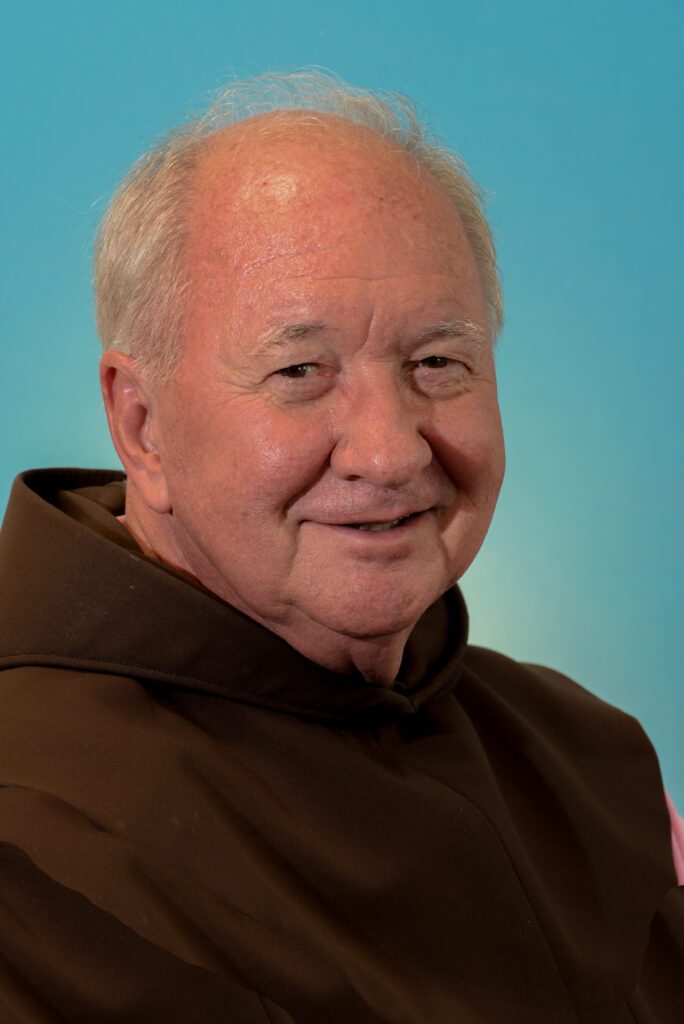
Fr. John Quigley, OFM, is approaching his 82nd birthday having devoted more than six decades to Franciscan life.
That ministry has been a varied one: co-leader of New Jerusalem, a vibrant charismatic community in Cincinnati; work on behalf of the promotion and protection of human rights with the United Nations; peace, justice and environmental concerns with the Franciscans, as well as on the world stage; extensive travels around the world, retreat work and preaching and, in recent years, artistry created in his Cincinnati studio.
That creative Franciscan life took shape in large part because the young John Quigley had trouble mastering high school French.
Growing up in London, Ontario, John knew he wanted to be a priest and planned to enter the local diocesan seminary. But he began reading about a famous medieval Italian saint, Francis of Assisi, and like thousands of others before and after, John set his sights on becoming a Franciscan.
There was a problem, however. There were no Franciscan communities at the time in Ontario, with the closest Canadian community located in Quebec. But his lack of facility in French made that a difficult option. Eventually he found out through a friend about a Franciscan seminary 100 miles away, south of the border in Detroit.
So, in 1962 John Quigley began his adventure in Franciscan formation and ministry.
In 1974, two years after his ordination, Fr. John became a co-leader of the New Jerusalem Community in Cincinnati, with fellow Franciscan and seminary friend Fr. Richard Rohr, OFM. For eight years he helped guide an intensely spiritual group forged out of the Charismatic Renewal. The community consisted of about 400 members, some of whom lived together in households. Most were young adults navigating their lives through the tumult of the 1960s and ‘70s.
“I fell in love with the group,” he recalled. The New Jerusalem Community became known worldwide for its prayer life and for forming a community among young adult Catholics seeking a spiritual path.

In 1982, Fr. John worked with his Franciscan brothers as director of the OFM Provincial Office for Peace and Justice, Cincinnati. In 1989 he entered an international phase, going to Rome as director of the Franciscans’ Office of Justice, Peace and the Integrity of Creation, connecting with friars and Franciscan Sisters around the world working among the oppressed.
In 1999, he joined Franciscans International in Geneva, working alongside others on social justice issues at the United Nations. He was there for 11 years, traveling the world connecting with Franciscan grassroot communities.
“We would work with the Franciscans in different areas of the world,” he said, noting that the friars’ presence among the poor provided valuable links to UN committees working in Geneva seeking improved conditions.
For example, he noted, a particular concern were the landless people of Brazil, a chronic issue dating to colonialism. While the wealthy control huge tracts of the land, many of the poorest are consigned to slums called favelas.
“They were the landless people. We would work with the Franciscans of Brazil and bring their concerns into the discussions about legislation and subsequent written international law. Our effort was to bring their voices with documentation and advocacy to the international community,” he said.
He returned to the United States in 2010 with a focus on preaching and spreading consciousness about St. Francis, coming full circle from his high school days in Ontario.
One of his goals today is to deliver a perspective on St. Francis that goes beyond the popular image of a placid man who loved nature and roamed the forests.
By contrast, Fr. John focuses on Francis, a defeated, imprisoned soldier, who suffered a traumatic year of captivity in Perugia.
“He was in prison for a full year,” said Fr. John. “That was so traumatic for him that it profoundly changed his perspective of his life and values. Francis’ conversion, said Fr. John, can be attributed in large part to his response to what modern medicine labels PTSD (Post-Traumatic Stress Disorder).

“We connect St. Francis with the beauty of our gardens, forests and oceans – idealizing him as a poetic, holy man – that patron saint of creation. Our romantic images of him miss the deeper reality of his life. He became saintly by the way he responded to disaster. Perhaps we have a similar path.”
Father John leads annual pilgrimages to Rome and Assisi, sharing these and other insights on the lives of Francis and Clare.
In the retreats he preaches, Fr. John also focuses on Jesus’ relationships and Catholic teaching on the Trinity as the dynamic union of Divine Love among three persons..
He doesn’t travel as much as he used to and is now largely content spreading his insights on activism, the arts and Franciscan spirituality around the Cincinnati area.
“Preaching helps me articulate and understand my beliefs and painting helps me search to a spiritual world – especially in times of loss and grief,” he said. He has a long connection to the arts, a passion he reignited after returning to Cincinnati from years aboard. His artistry includes wood block silkscreen prints, sculpture, and paintings. He has depicted saints, including Pope John XXIII, Mary and Mark, the evangelist, and is an illustrator for books on Franciscan and other themes.
His interest in art has allowed him to expand his ministry as a friar. “I like to defuse some of the hostility (towards the church), especially among people who are active in the arts,” he said.
His focus is on exploring the world of the unconscious and forging relationships among spiritual seekers.
“What I really love to do is bring people into a deeper level in their own world, and help them to connect, because there are a lot of people who have a wonderful sensitivity to social justice, but they just don’t know where to go. I love to bring that together.”